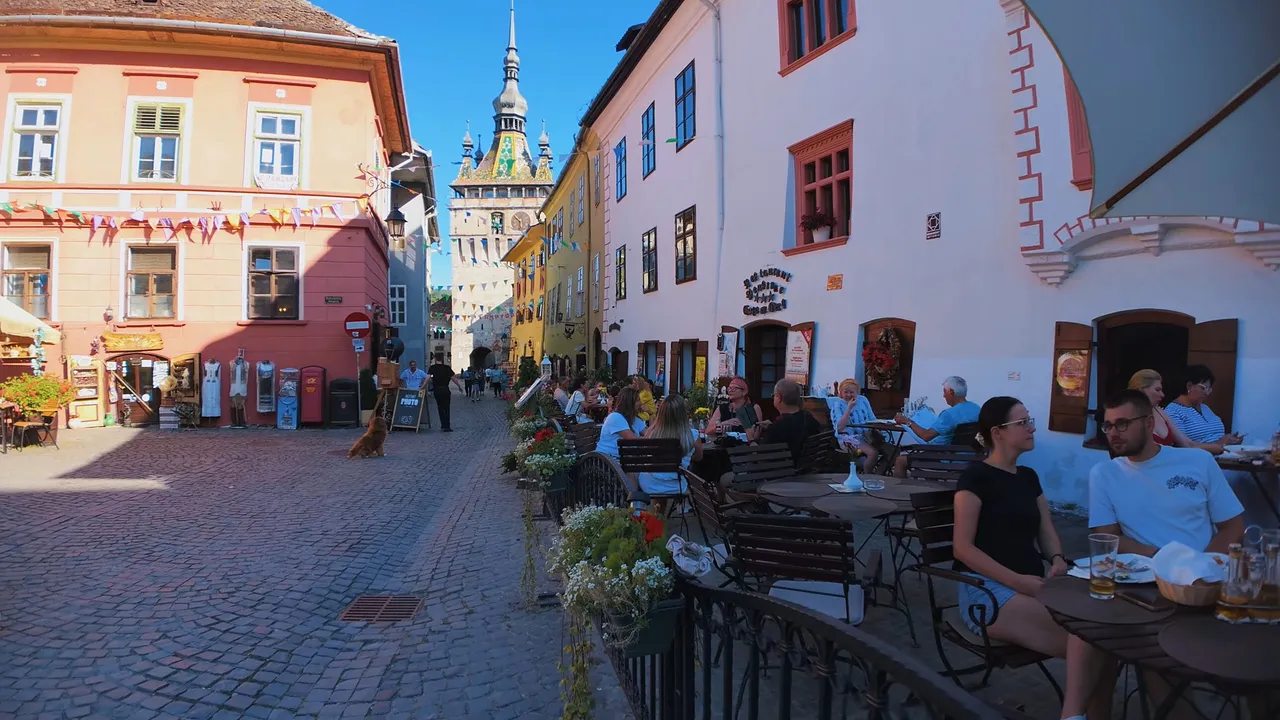
The route, stop by stop
A loop that starts and ends at the citadel gate. The film opens with a short preview, and the walk itself begins at 1:32. We go down to the lower town first, climb back up under the Clock Tower, circle the upper citadel and its outer walls, then finish with the covered stairs and the cemetery on the hill. Tap a time to jump to that moment in the film.
- The citadel gate, Strada Zidul CetățiiA stone arch in the old walls. The walk proper starts here, right after the film’s short preview.▶ 1:32
- Down the stone stairs to the lower townSteps between garden walls with views over the rooftops. Most visitors head the other way.▶ 6:40
- The lower town and the umbrella lanePiața Hermann Oberth, the town park, and a café lane hung with colorful umbrellas.▶ 14:40
- The Clock TowerThe citadel’s main gate tower, about 64 meters tall, reached through a wooden gallery of local paintings.▶ 20:18
- The Monastery ChurchA Gothic church that began as part of a Dominican monastery, beside the Clock Tower.▶ 22:40
- Vlad Țepeș bust, Piața MuzeuluiA bronze bust of Vlad the Impaler in a small square with flags strung overhead.▶ 23:32
- City Hall and the terrace viewThe late-1800s City Hall, with a terrace looking over the lower town and the hills.▶ 28:41
- St Joseph’s ChurchThe Roman Catholic church in the citadel’s northern corner, built in the 1890s.▶ 31:30
- Petőfi bust and parkA small park with a bust of the Hungarian poet Sándor Petőfi.▶ 32:02
- Shoemakers’ Tower and the outer wallsOne of the old guild towers. From here we walked outside the walls and came back in through the Tailors’ Gate.▶ 32:27
- Casa Vlad DraculThe yellow house where Vlad the Impaler is traditionally said to have been born, now a restaurant.▶ 44:00
- The Scholars’ StairsA covered wooden stairway of 175 steps, built so pupils could reach the hilltop school in winter.▶ 48:00
- The Church on the HillA Gothic church at the top of the stairs, with views over the whole citadel.▶ 52:05
- The Saxon cemetery and the walk back downOld headstones under tall firs, past the Rope-makers’ Tower, then back down the stairs and out through the gate.▶ 53:51
Open this route in Google MapsWalking directions from Strada Zidul Cetății through the main landmarks. Our film takes a few extra turns.
Sighișoara caught me by surprise. We walked it in early August, and I came for the medieval citadel and the Dracula story, but left talking about the people: warm, welcoming, and quick to help. The town is full of life and color, with flowers spilling from window boxes, small gardens and pastel houses on every lane.
Where Sighișoara is
Sighișoara sits on the Târnava Mare River in Mureș County, in the heart of Transylvania in central Romania. It is an easy day trip or overnight stop on a road trip between Brașov and Cluj-Napoca. The lower town is a working town of around 24,000 people. Above it, on a hill, sits the walled citadel, one of the few medieval citadels in Europe that is still lived in. People go to school, work and live inside the walls, and that is what makes walking it feel so different from a museum.
Dracula’s birthplace
Transylvanian Saxon craftsmen and merchants settled here in the 12th century and built the fortified town, with towers that each belonged to a guild. Its best-known son came later. Vlad III, remembered as Vlad the Impaler, was probably born here between 1428 and 1431, while his father Vlad Dracul lived in the town. The house where tradition says he was born stands near the Clock Tower and is now a restaurant.
The name is where Dracula comes from. His father belonged to the Order of the Dragon, which earned him the name Dracul, and “Dracula” means “son of Dracul.” Centuries later, Bram Stoker gave the name to his vampire. The citadel became a UNESCO World Heritage Site in 1999.
Getting up to the citadel
If you drive or take a ride share, you will be dropped below the citadel, then face a short but steep walk up. Take it slowly in summer. Small shops at the base of the hill are a good place to cool off on the way up, and you will find the same inside the walls once you arrive.
At the top, the 64-meter Clock Tower is the landmark you will keep catching between rooftops. Inside, it houses the town’s history museum. From the citadel, the wooden Covered Stairs, built in 1642, climb to the Church on the Hill.
The covered stairs, and why they exist
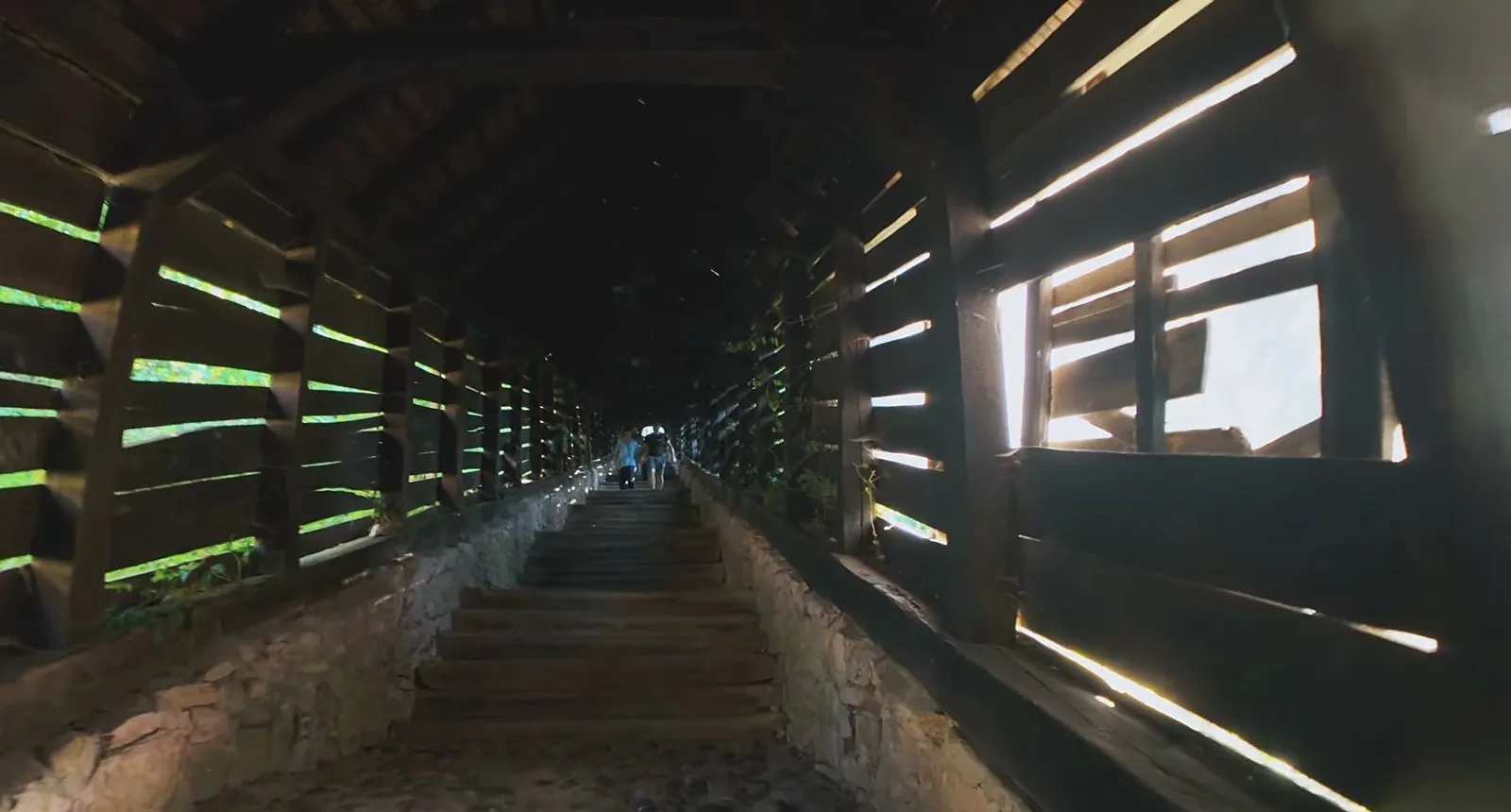 Inside the Scholars’ Stairs, about 48 minutes into the film.
The Scholars’ Stairs were built in the 1600s so that pupils could reach the school on top of the hill in winter without slipping on ice and snow. The wooden roof and slatted walls kept the weather off. There are 175 steps today, and climbing them is free.
At the top you come out beside the Church on the Hill, a Gothic church that looks out over the whole town, and the Saxon Evangelical cemetery climbing the slope behind it.
What to eat and drink
Transylvanian food is hearty, and the citadel’s terraces are the place to try it:
- Ciorbă: my favorite by far. Romania’s sour soup has cousins across the region, from Turkish çorba to the Persian version, but this one was light and full of flavor.
- Papanași: fried doughnuts topped with sour cream and jam. It’s addictive, and if you try only one thing here, make it this.
- Sarmale: cabbage rolls stuffed with minced meat and rice, usually served with polenta.
- To drink: țuică, a strong plum brandy, or a glass of local white wine from the Târnave valleys.
The people
What I remember most is how friendly everyone was. Shopkeepers and restaurant staff greeted us like neighbors, and English was widely spoken, especially by younger people and anyone working in tourism, so getting around was easy.
What the camera doesn’t tell you
We drove in from Cluj-Napoca, a little under three hours through the Transylvanian hills, and parked below the walls. Most people walk straight up to the Clock Tower. We did the opposite and took the old stone stairs down into the lower town first, where the cafés hang umbrellas over the lane and the locals are going about their Saturday. ▶ watch at 14:40
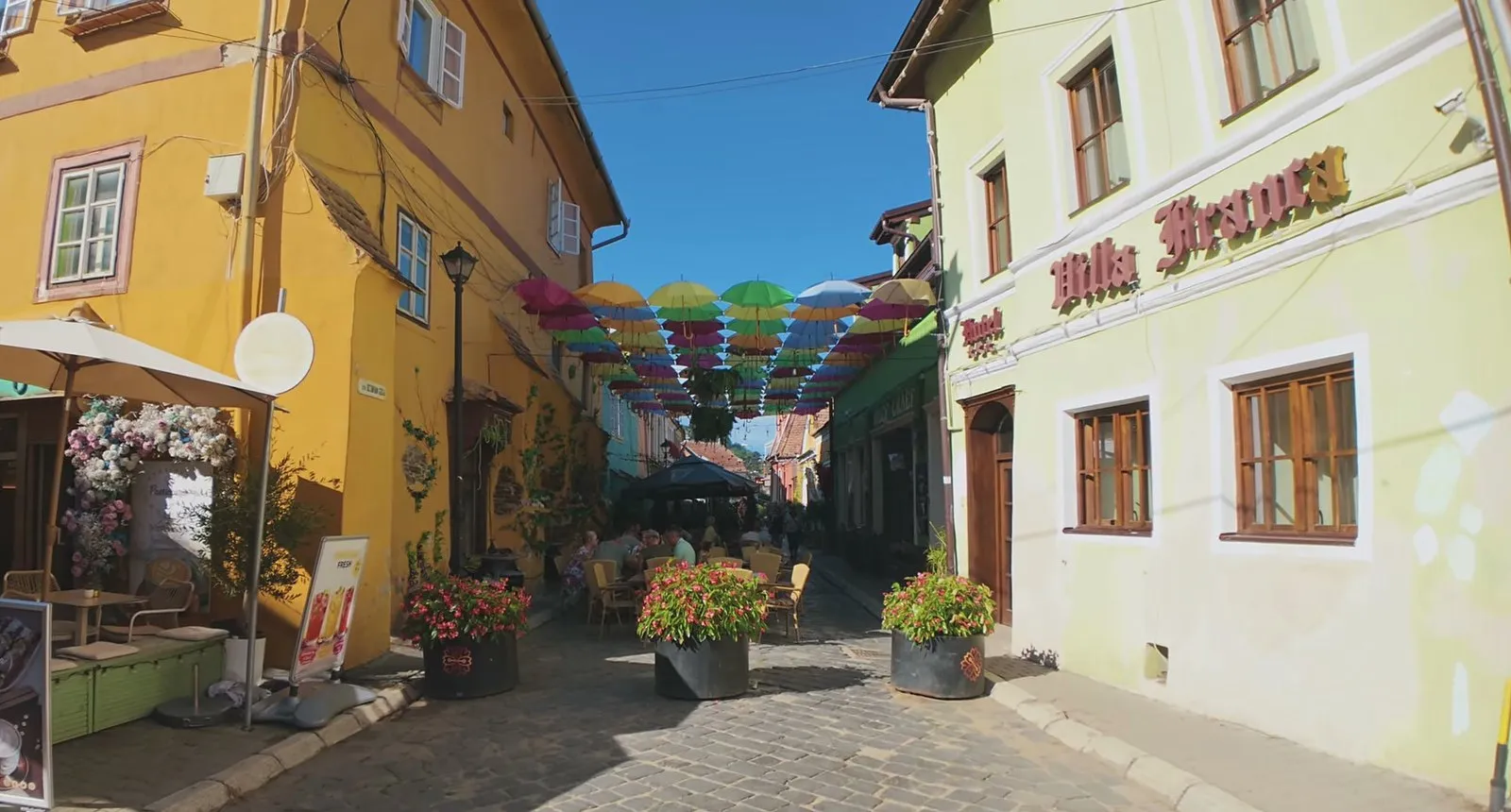 The umbrella lane in the lower town.
Coming back up, you reach the Clock Tower from underneath, through a wooden gallery hung with local paintings. ▶ watch at 20:18 Near Casa Vlad Dracul, a ginger cat had claimed the cobbles outside a café and wasn’t moving for anyone. ▶ watch at 45:02
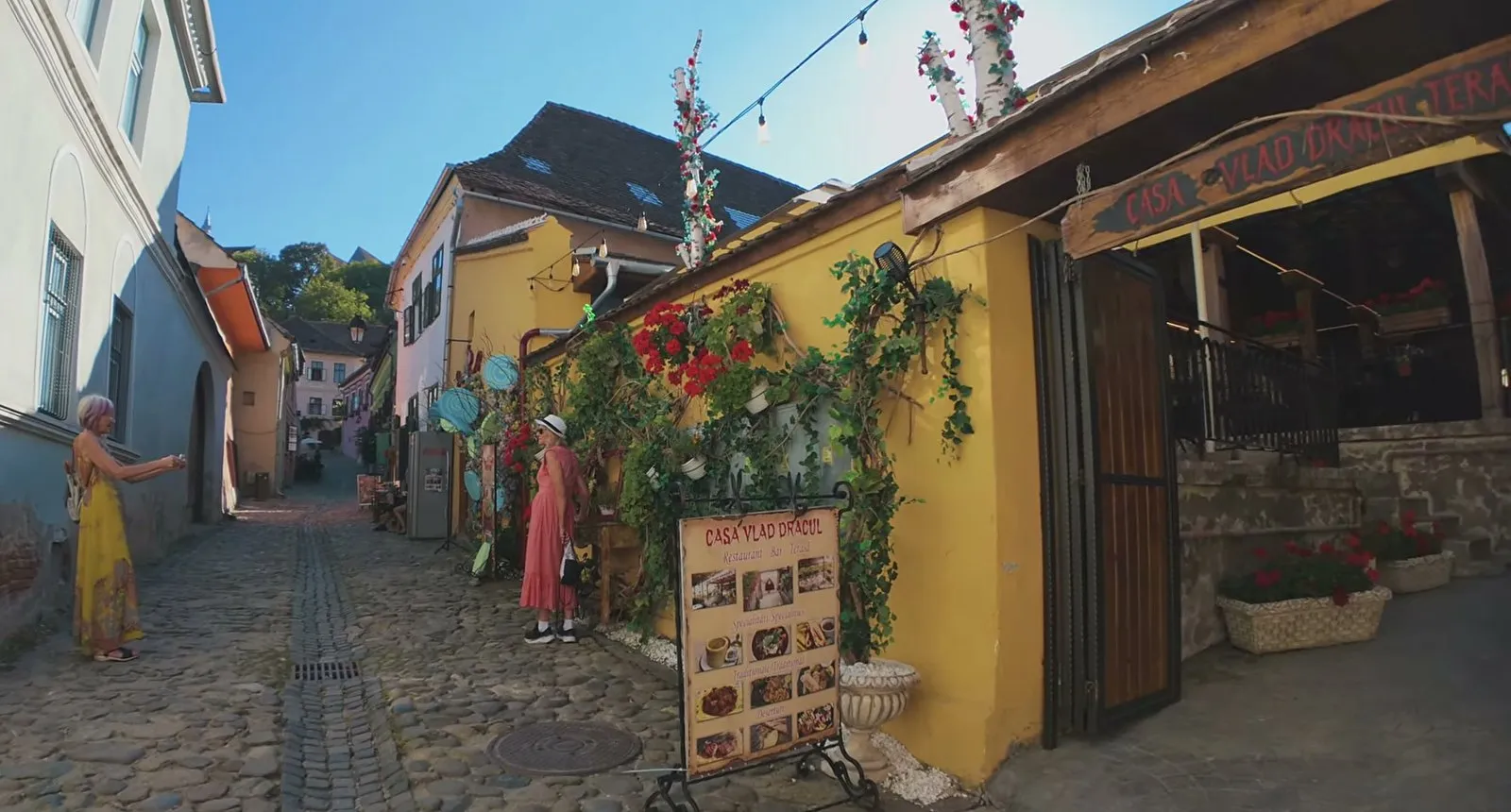 Casa Vlad Dracul, traditionally the birthplace of Vlad the Impaler, 44 minutes into the film.
The best part came last. Inside the covered stairs the light falls through the slats in stripes, and someone was playing guitar at the top. ▶ watch at 49:58 By the time we reached the cemetery the sun was low, coming through the fir trees onto old Saxon headstones, and the town below had gone quiet. ▶ watch at 54:15
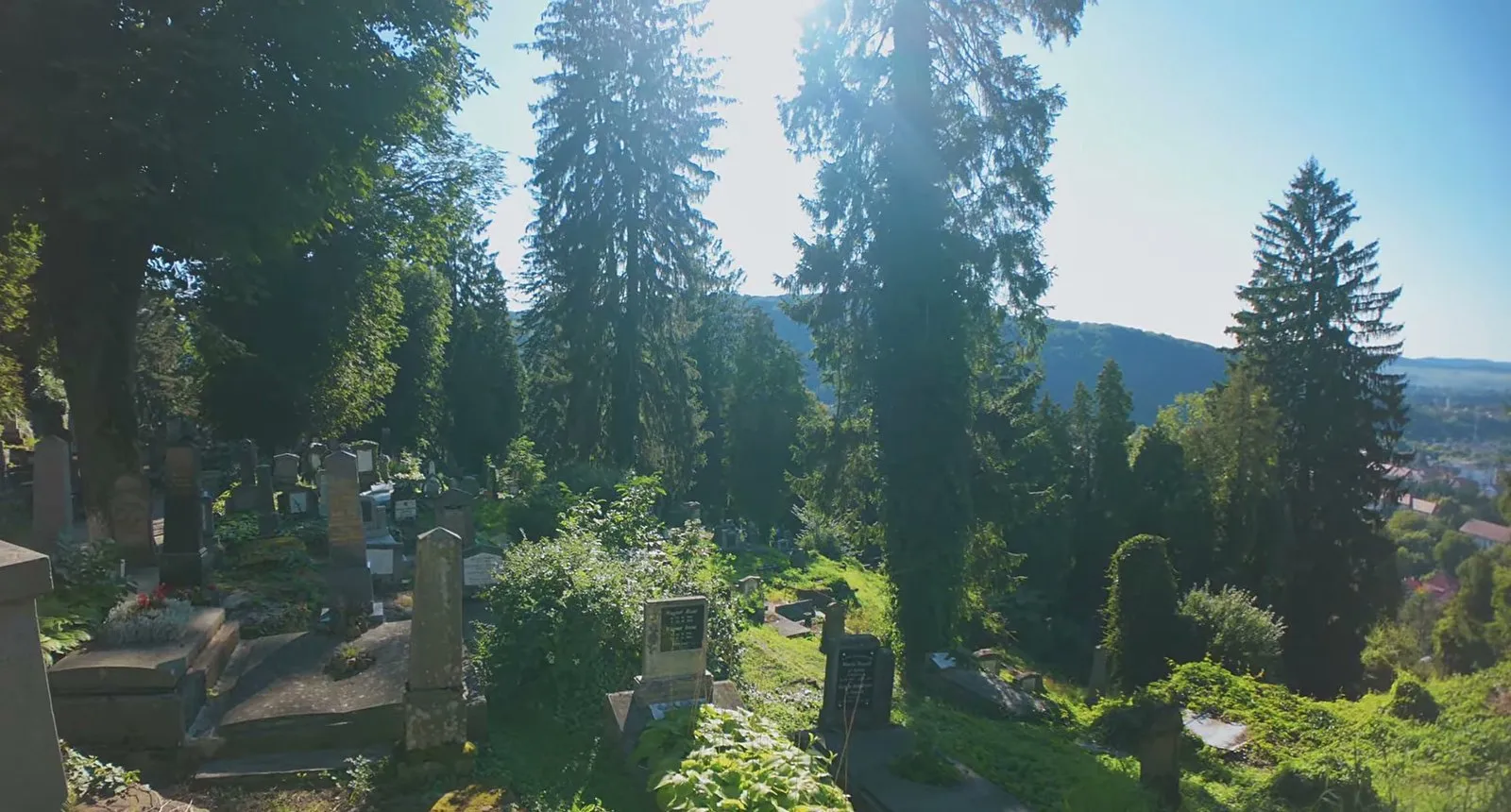 The Saxon cemetery on the hill, near the end of the walk.
One more thing. Look closely at 4:16, on a sunny stretch of cobbles: the shadow in the corner is us. ▶ watch at 4:16
Is it worth the trip?
Yes. Sighișoara is one of Romania’s best-known stops. Its history museum counted around 138,000 visitors in 2022, close to double the number three years earlier. Every July the citadel hosts a medieval festival, the busiest time of year.
Tips for your visit
- Wear comfortable shoes. The streets are cobbled and the climb is steep.
- Arrive early or stay into the evening to see the citadel at its quietest.
- In summer, bring water and plan breaks in the shade.
- Give it a full day, or stay overnight inside the walls.
What it costs
| This walk: the streets, the walls and the Scholars’ Stairs | Free |
|---|---|
| Clock Tower and History Museum | 50 lei (15 lei students) |
| Church on the Hill | 15 lei |
| All three town museums (Clock Tower, weapons, torture room) | 70 lei |
| Our drive from Cluj-Napoca | about 2 h 40 min each way |
| Our Airbnb in Cluj-Napoca | $66.52 a night |
We walked the whole loop from the outside, so it cost us nothing. Museum prices are from the town hall’s 2026 list and church prices from the parish; both can change.
Where to stay for this walk
We did Sighișoara as a day trip from an Airbnb in Cluj-Napoca, for $66.52 a night in late July. If you have the time, though, sleep in Sighișoara itself: the citadel after the day-trippers leave is a different place.
Driving tip: cars can't go far inside the citadel. Park below the walls and walk up.
Worth paying to go inside
- The Clock Tower and History MuseumClimb the tower for the view over the rooftops. 50 lei, 15 lei for students, or 70 lei with the weapons collection and torture room.Official site ↗
- The Church on the HillThe Gothic church at the top of the Scholars’ Stairs, open daily 9 am to 6 pm. 15 lei.Official site ↗
- Casa Vlad DraculThe traditional birthplace of Vlad the Impaler. Most of the house is a restaurant now. We didn’t go in, so ask at the door what the exhibition costs.
Questions people ask
Is Sighișoara worth a day trip?
Yes. We did it as a day trip from Cluj-Napoca, about 2 hours 40 minutes each way by car, and the full loop in our film fits easily into an afternoon. If you can, stay a night inside the citadel.
Was Dracula really born in Sighișoara?
Vlad III, known as Vlad the Impaler and the historical figure linked to the Dracula legend, is traditionally said to have been born in Sighișoara around 1431, in the house now called Casa Vlad Dracul. It is on this walk at 44:00.
Are the Scholars’ Stairs free?
Yes. The covered wooden stairway is free to climb. It has 175 steps and leads to the Church on the Hill and the Saxon cemetery.
How long does this walk take?
Our film is 1:09:21, and the walk starts at 1:32. With time to look around, allow two to three hours, more if you go inside the Clock Tower and the churches.
Is the citadel hard to walk?
It is hilly, with cobbles and steps, but compact. The steepest parts are the stone stairs to the lower town and the covered stairs up the hill.
Facts and prices checked October 2026. Opening hours and ticket prices change, so check official sites before you go.